
NEET Biology Previous Year Questions (2024–2025)
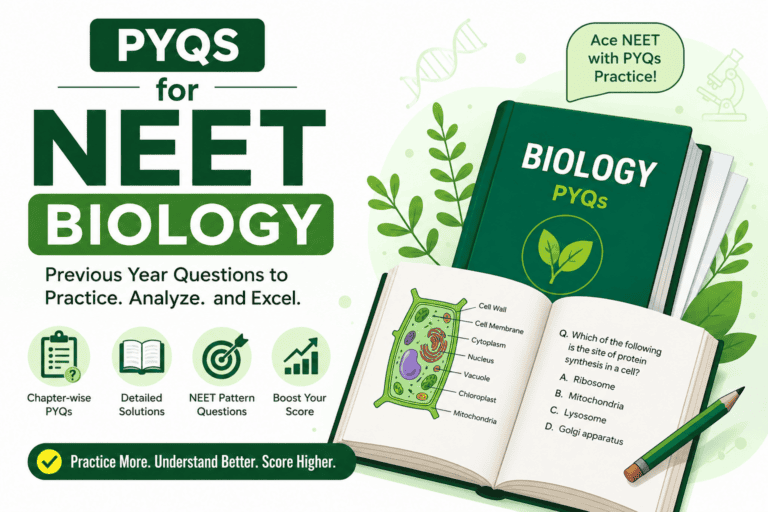
NEET Biology PYQs 2025: 190 Solved Questions – Online Practice — Practice Questions
1. The complex II of mitochondrial electron transport chain is also known as:
- (A) Cytochrome bc1
- (B) Succinate dehydrogenase
- (C) Cytochrome c oxidase
- (D) NADH dehydrogenase
Answer: (B) Succinate dehydrogenase
Complex II is succinate dehydrogenase, which oxidizes succinate to fumarate and transfers electrons to ubiquinone.
2. Polymerase chain reaction (PCR) amplifies DNA following the equation:
- (A) N^2
- (B) 2^n
- (C) 2n+1
- (D) 2N^2
Answer: (B) 2^n
Each PCR cycle doubles the DNA amount, so after n cycles the amplification factor is 2^n.
3. What are the potential drawbacks in adoption of the IVF method? A: High fatality risk to mother. B: Expensive instruments and reagents. C: Husband/wife necessary for being donors. D: Less adoption of orphans. E: Not available in India. F: Possibility early embryo does not survive.
- (A) B, D, F only
- (B) A, C, D, F only
- (C) A, B, C, D only
- (D) A, B, C, E, F only
Answer: (A) B, D, F only
IVF drawbacks include high cost of instruments/reagents (B), reduced adoption of orphans since IVF is chosen instead (D), and risk that the early embryo may not survive (F); high maternal fatality, donor restriction, and unavailability in India are not correct drawbacks.
4. Name of blood vessel that carries deoxygenated blood from body to heart in a frog is:
- (A) Aorta
- (B) Pulmonary artery
- (C) Pulmonary vein
- (D) Vena cava
Answer: (D) Vena cava
In frogs, the vena cava (venae cavae) collects deoxygenated blood from the body and returns it to the heart.
5. Which statement refers to Reductionist Biology?
- (A) Physico-chemical approach to study living organisms
- (B) Physiological approach to study living organisms
- (C) Chemical approach to study living organisms
- (D) Behavioural approach to study living organisms
Answer: (A) Physico-chemical approach to study living organisms
Reductionist biology explains life processes through the physico-chemical properties and interactions of molecules.
6. Statement I: In RNA world, RNA was the first genetic material and also acted as a catalyst; being reactive, RNA is unstable. Statement II: DNA evolved from RNA, being double helical/complementary it resists changes via repair mechanisms. Choose the correct option.
- (A) Both statement I and II are correct
- (B) Both statement I and II are incorrect
- (C) Statement I correct, II incorrect
- (D) Statement I incorrect, II correct
Answer: (A) Both statement I and II are correct
Both statements are correct: RNA served as genetic material/catalyst but is unstable, while DNA's stable double-helical structure with repair mechanisms made it the preferred genetic material.
7. Epiphytes growing on a mango branch is an example of:
- (A) Commensalism
- (B) Mutualism
- (C) Predation
- (D) Amensalism
Answer: (A) Commensalism
Epiphytes benefit (support and sunlight access) while the host tree is unaffected, which is commensalism.
8. Choose the correct option: A: Eukaryotic ribosomes are 80S, prokaryotic 70S. B: Each ribosome has two subunits. C: 80S subunits are 60S+40S, 70S are 50S+30S. D: 80S subunits are 60S+20S, 70S are 50S+20S. E: 80S subunits are 60S+30S, 70S are 50S+30S.
- (A) A, B, C are true
- (B) A, B, D are true
- (C) A, B, E are true
- (D) B, D, E are true
Answer: (A) A, B, C are true
Statements A, B, C are the correct facts about ribosome types and subunit composition; D and E give incorrect subunit values.
9. Which is an example of ex-situ conservation?
- (A) National Park
- (B) Wildlife Sanctuary
- (C) Zoos and botanical gardens
- (D) Protected areas
Answer: (C) Zoos and botanical gardens
Ex-situ conservation means protecting species outside their natural habitat, as done in zoos and botanical gardens.
10. Statement I: Primary source of energy in an ecosystem is solar energy. Statement II: Rate of production of organic matter during photosynthesis in an ecosystem is called net primary productivity (NPP). Choose correct option.
- (A) Both statement I and II correct
- (B) Both statement I and II incorrect
- (C) Statement I correct, II incorrect
- (D) Statement I incorrect, II correct
Answer: (C) Statement I correct, II incorrect
Statement I is correct (solar energy is the primary source); Statement II is incorrect since the rate of organic matter production during photosynthesis is gross primary productivity (GPP), not NPP.
11. Match List-I (Emphysema, Angina Pectoris, Glomerulonephritis, Tetany) with List-II (descriptions).
- (A) A-III,B-I,C-IV,D-II
- (B) A-III,B-I,C-II,D-IV
- (C) A-II,B-IV,C-III,D-I
- (D) A-II,B-III,C-IV,D-I
Answer: (D) A-II,B-III,C-IV,D-I
Emphysema = damaged alveolar walls (II); Angina pectoris = chest pain from low oxygen to heart (III); Glomerulonephritis = inflammation of glomeruli (IV); Tetany = muscle spasms from low Ca2+ (I); giving A-II,B-III,C-IV,D-I.
12. Assertion: Both wind and water pollinated flowers are not very colourful and do not produce nectar. Reason: These flowers produce enormous pollen grains. Choose correct option.
- (A) Both A and R true, R correct explanation of A
- (B) Both A and R true, R not correct explanation of A
- (C) A true, R false
- (D) A false, R true
Answer: (B) Both A and R true, R not correct explanation of A
Both statements are factually true, but the reason (large pollen production) explains why wind/water pollination is inefficient rather than explaining the lack of colour/nectar directly, so R is not the correct explanation of A.
13. Which is an example of non-distilled alcoholic beverage produced by yeast?
- (A) Whisky
- (B) Brandy
- (C) Beer
- (D) Rum
Answer: (C) Beer
Beer and wine are produced without distillation, whereas whisky, brandy, and rum require distillation of the fermented broth.
14. Statement I: In floral formula, (+) stands for zygomorphic nature and G for inferior ovary. Statement II: (+) stands for actinomorphic nature and G for superior ovary. Choose correct option.
- (A) Both statement I and II correct
- (B) Both statement I and II incorrect
- (C) Statement I correct, II incorrect
- (D) Statement I incorrect, II correct
Answer: (D) Statement I incorrect, II correct
By floral formula convention, the plus/oplus symbol denotes actinomorphic (not zygomorphic) flowers, and underlined G denotes superior ovary, so Statement I is incorrect and Statement II is correct.
15. Streptokinase produced by bacterium Streptococcus is used for:
- (A) Curd production
- (B) Ethanol production
- (C) Liver disease treatment
- (D) Removing clots from blood vessels
Answer: (D) Removing clots from blood vessels
Streptokinase acts as a clot buster, used to remove clots from blood vessels of patients after myocardial infarction.