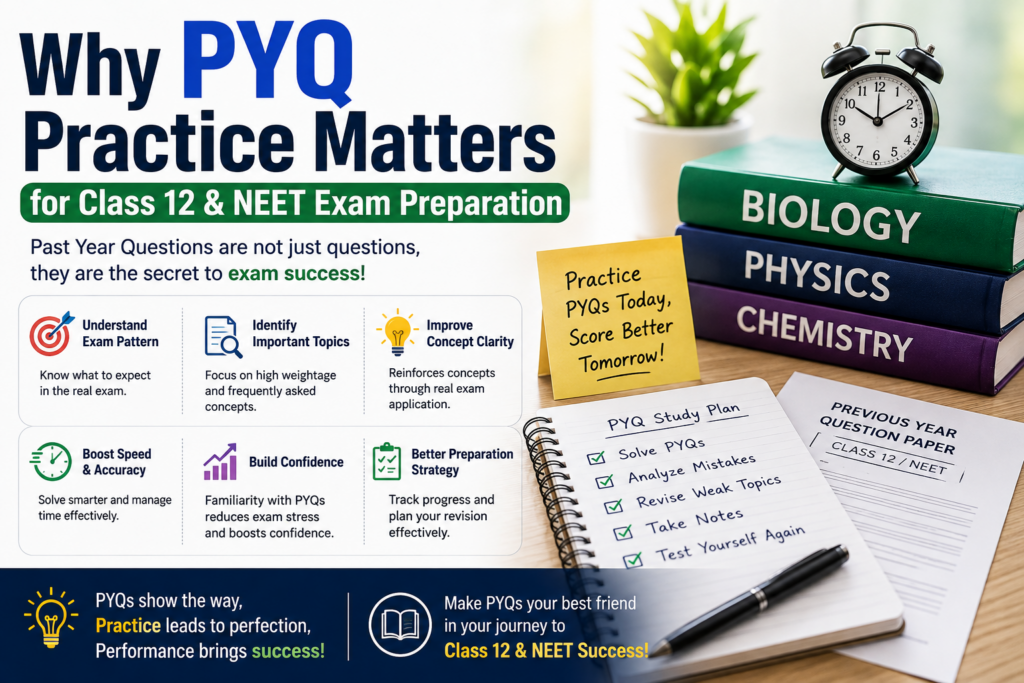
Ask any Class 12 topper or NEET qualifier how they prepared, and PYQs come up almost every time. Ask why, and most students give a vague answer — “it helps you understand the pattern.” True, but that’s only half the story.
PYQs don’t just show you what was asked in your board exam or in NEET. They show you how each exam thinks — which concepts CBSE keeps returning to in board papers, how NEET likes to twist a straightforward NCERT line into an application-based question, and where the real difficulty in a “syllabus” actually lives once it’s turned into an actual question.
That’s a very different kind of information than anything a textbook or a random question bank can give you — and it’s especially useful when you’re juggling both Class 12 boards and NEET at the same time, since the same NCERT chapter gets tested very differently by each.
What PYQs Actually Are (and Aren’t)
A previous year question is exactly what it sounds like — a question that has genuinely appeared in a real CBSE board paper or an actual NEET exam in an earlier year. Not a question written to resemble the exam. Not a question predicted to be similar. The real thing, asked to real students, in a real exam hall.
That distinction matters more than people give it credit for.
Sample papers and question banks are written by teachers or content teams trying to guess what the board exam or NEET might ask. Sometimes they’re close. Often they’re not — they lean too hard on textbook phrasing, or they’re pitched at the wrong difficulty level entirely, whether that’s too easy for NEET’s competitive standard or oddly harder than what CBSE typically asks.
PYQs carry no guesswork. They’re proof of what CBSE and NTA have actually asked, which makes them the most reliable data you have about what either exam is likely to do again.
Practice MCQs free — Class 12 & NEET
Chapter-wise practice with instant answers at MCQAdda
Why PYQs Change How You Prepare — for Boards and NEET Differently
They reveal the real exam pattern — and it’s not the same for both exams. Reading the NCERT syllabus tells you what topics exist. Solving PYQs tells you how those topics get converted into actual questions — and Class 12 boards test very differently from NEET, even on the same chapter. CBSE tends to reward structured, step-by-step answers and direct NCERT recall; NEET compresses the same concept into a single MCQ that often twists the wording or combines it with another idea. A student who only prepares for one format can be caught off guard by the other.
📘 NEET Biology PYQs 2024–2025 | Online Practice
Practice recent NEET Biology previous year questions with instant answers, explanations, and a score after every attempt. [Start Practicing →]
They calibrate difficulty. Plenty of students study a chapter thoroughly for their board exam and still assume they’re “NEET-ready” on it — until a NEET PYQ shows them the question is pitched at a level or angle they didn’t expect. That gap between “I can write this in my board answer sheet” and “I can answer this the way NEET phrases it” is one of the most common reasons NEET prep falls short for otherwise strong board students, and PYQs are the fastest way to close it.
They surface topics that repeat. Both CBSE boards and NEET have chapters that show up almost every year, in some form — Human Physiology and Genetics for NEET Biology, for instance, or specific high-weightage numericals in board Physics. Solve enough years of papers from either exam and these patterns become obvious.
📘 Class 12 Biology Last 5 Years MCQs – Online Practice
Practice last 5 years questions with instant answers, explanations, and a score after every attempt. [Start Practicing →]
They build genuine exam-day composure. There’s a real difference between solving a question casually at your desk and solving the same question under a ticking clock, formatted exactly the way your board paper or the NEET OMR sheet formats it. PYQs, especially when solved under timed conditions, are the closest rehearsal you’ll get before either exam day.
They turn revision into something targeted. Instead of revising every chapter with equal effort for boards and NEET both, your PYQ performance tells you exactly where to spend the next week — and whether a weak chapter needs board-style depth, NEET-style speed, or both.
How Much of the Exam Actually Overlaps With PYQs?
This varies by exam and by subject, and any specific percentage you see quoted online should be treated as a rough estimate rather than a guarantee — no exam repeats questions word-for-word on purpose. But the pattern is consistent across both exams: a meaningful share of each year’s NEET Biology paper draws on concepts, question styles, or even near-identical framing from previous years, since Biology leans heavily on direct NCERT recall. CBSE board papers show a similar tendency — certain diagram-based, derivation, or numerical-type questions reappear in some form almost every cycle, even if the exact numbers change.
The honest takeaway isn’t “memorize old papers and you’re set.” It’s that the concepts and patterns PYQs expose keep resurfacing in both your board paper and NEET — so time spent on them compounds in a way that random practice doesn’t.
Why Solving PYQs Online Works Better Than a PDF or a Printed Book
Most students still solve PYQs the old way — a downloaded PDF or a printed book, an answer key at the back, and a lot of flipping pages to check whether they got it right. It works, but it’s slower than it needs to be, and it usually skips the part that actually teaches you anything.
Practicing PYQs on an online platform changes a few things that matter more than they might seem at first:
Instant answers mean you’re not losing momentum. Flipping to the back of a book breaks your flow and makes it tempting to peek at the answer before you’ve genuinely attempted the question. Instant checking keeps you moving through a real practice session instead of a slow, start-stop one.
Explanations turn a wrong answer into an actual lesson. A printed answer key tells you the correct option and nothing else. A proper explanation tells you why that option is correct and why the one you picked wasn’t — which, as covered above, is where most of the real learning happens. Without that, a wrong answer is just a red mark; with it, it’s a specific gap you now know how to fix.
A score after every session gives you something to track. One PDF of past papers doesn’t tell you whether you’re actually improving. A running score across sessions does — you can watch a topic go from 55% accuracy to 75% over a few weeks, which is the kind of concrete feedback that both directs your revision and keeps you motivated when the syllabus feels endless.
It’s faster to isolate a chapter. Rather than hunting through a printed paper for every question related to, say, Genetics and Evolution, an online set lets you pull just that chapter’s PYQs across multiple years in seconds — which fits directly into the chapter-wise approach covered in the next section.
None of this replaces the actual studying. But when the practice itself is faster, better explained, and easier to track, you end up doing more of it — and consistency is most of what makes PYQ practice work in the first place.
How to Actually Use PYQs (Not Just Solve Them)
Solving PYQs passively — just to get through them — wastes most of their value. A more useful approach, whether you’re prepping for boards, NEET, or both:
Go chapter-wise before you go year-wise. After finishing a chapter, pull every PYQ related to it — both board PYQs and NEET PYQs — across the last several years, rather than solving a full random year first. This tells you immediately how that specific topic tends to get tested in each exam.
Separate your board prep and NEET prep for the same chapter. Don’t assume solving NEET MCQs on a topic is enough revision for your board answer-writing, or vice versa. Boards reward structured written answers; NEET rewards fast, accurate MCQ recognition. Practice both PYQ types deliberately.
Time yourself once you’re comfortable. Early on, solve without a clock — the goal is understanding. Once the basics are solid, start timing yourself: 3 hours 20 minutes for a full NEET-style attempt, or your board’s actual exam duration for a full paper.
Don’t stop at “correct” or “incorrect.” For every question, ask why the right answer is right and why the option you almost picked was wrong. That second half is where most of the actual learning happens.
Track recurring weak spots. If the same type of question keeps catching you off guard across different years — in your board subject or in NEET — that’s not bad luck. It’s a specific gap worth going back to fix.
Solve full papers closer to the exam. Chapter-wise practice builds understanding; full previous-year papers, solved start to finish under real time limits, build exam stamina and pacing for both your board paper and NEET.
How Many Years of PYQs Should You Solve?
For NEET, a reasonable range that most serious aspirants work through is the last 8-10 years, with more recent years given priority since they best reflect the current exam pattern and syllabus. For Class 12 boards, the last 5-10 years of CBSE papers for your subject is generally enough, since board question patterns tend to shift less dramatically year to year than a competitive exam’s do.
Older papers can still be useful for concept reinforcement, but formats and difficulty levels do shift over time in both cases, so don’t treat a much older paper as equivalent to last year’s.
Common Mistakes Students Make With PYQs
- Solving them too early, before the underlying concept is actually understood — this turns PYQ practice into guesswork rather than application.
- Checking the answer immediately instead of genuinely attempting the question first.
- Only solving PYQs from one or two recent years, missing the broader pattern that only shows up across a longer stretch.
- Never revisiting a PYQ after getting it wrong — solving it once and moving on skips the entire point of reviewing mistakes.
- Treating PYQs as the only form of preparation. They’re a powerful tool, not a replacement for building the underlying concept in the first place.
Frequently Asked Questions
Are PYQs enough on their own to prepare for Class 12 boards and NEET? No. PYQs are most effective when paired with solid NCERT-based conceptual study first — they show you how to apply what you’ve learned, but they can’t teach the concept from scratch if you haven’t studied it yet.
Do NEET questions actually repeat exactly in future years? Rarely word-for-word, but the underlying concepts, question styles, and difficulty patterns do tend to recur — especially in Biology — which is why NEET PYQs remain valuable year after year.
Should I prepare NEET PYQs and board PYQs separately, or is one enough? Separately, ideally. The same NCERT chapter gets tested very differently in a board answer sheet versus a NEET MCQ, so practicing only one format leaves a real gap in the other.
Should I solve PYQs before or after finishing the syllabus? Both, in different ways. Solve chapter-specific PYQs right after covering that chapter in class or self-study, and save full timed papers — board or NEET — for closer to the exam once your overall syllabus coverage is more complete.
What if I keep getting NEET PYQs wrong even after revising for boards? That usually points to a gap in application rather than knowledge — you may understand the concept well enough to answer it on a board paper but not yet recognize how NEET likes to test it. More targeted NEET PYQ practice on that specific chapter, followed by a careful review of explanations, tends to close this gap faster than general revision.
The Real Takeaway
PYQs work because they remove the guesswork — for both your board exam and NEET. Instead of preparing for an exam you’re imagining, you’re preparing for the ones that have actually been asked, year after year, by CBSE and by NTA — and that’s about as close to a reliable map as exam prep gets.
Used consistently and reviewed properly, they turn “I hope I studied the right things for both exams” into “I know exactly how each one tests what I studied.” That shift alone is often the difference between a good result and a great one — in your board marksheet and your NEET rank.