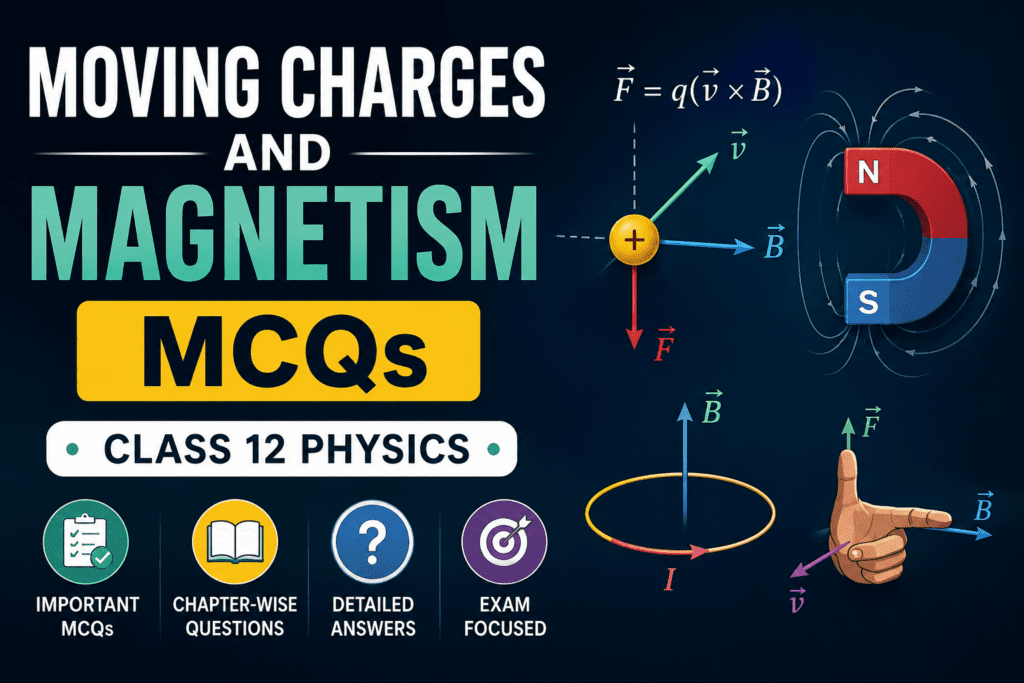
If you are a Class 12 student preparing for board exams or competitive entrance tests like JEE or NEET, Moving Charges and Magnetism is one chapter you simply cannot afford to skip. It carries good weightage, the concepts are interconnected, and once you understand the logic — the MCQs become surprisingly predictable.
This article gives you the most important MCQs from Moving Charges and Magnetism with clear answers and explanations written in plain language — not just the formula, but the actual reasoning behind each answer. Go through them slowly, understand the concept behind every question, and you will notice patterns that repeat across every exam.
Moving Charges and Magnetism MCQs with Answers and Explanation
Q1. A charged particle moves in a uniform magnetic field. Which of the following remains constant?
- A) Speed
- B) Velocity
- C) Kinetic energy changes
- D) Both A and C
Answer: D) Both A and C
Explanation: The magnetic force on a charged particle is always perpendicular to its velocity. A perpendicular force does no work, which means it cannot change the kinetic energy or the speed of the particle. Only the direction of velocity changes — not its magnitude. So speed and kinetic energy both stay constant throughout the motion.
Q2. What is the SI unit of magnetic field strength (B)?
Practice MCQs free — Class 12 & NEET
Chapter-wise practice with instant answers at MCQAdda
- A) Gauss
- B) Weber
- C) Tesla
- D) Ampere/metre
Answer: C) Tesla
Explanation: The SI unit of magnetic field B is Tesla (T). One Tesla is defined as the magnetic field that exerts a force of one Newton on a charge of one Coulomb moving at one metre per second perpendicular to the field. Gauss is the CGS unit — 1 Tesla equals 10,000 Gauss.
Q3. A long straight conductor carries a current I. The magnetic field at a distance r from it is:
- A) Directly proportional to r
- B) Inversely proportional to r²
- C) Inversely proportional to r
- D) Independent of r
Answer: C) Inversely proportional to r
Explanation: From Ampere’s law, the magnetic field due to a long straight conductor is given by B = μ₀I / 2πr. This clearly shows B is inversely proportional to r — as you move farther from the wire, the magnetic field weakens. This is a very commonly tested formula so make sure you remember the exact form.
Q4. The force between two parallel wires carrying currents in the same direction is:
- A) Repulsive
- B) Attractive
- C) Zero
- D) Depends on the magnitude of current
Answer: B) Attractive
Explanation: Two parallel wires carrying currents in the same direction attract each other. This is because the magnetic field produced by one wire acts on the current of the other wire, and the resulting force pulls them together. Opposite current directions produce repulsion. This is also the principle used to define one Ampere in SI units.
Q5. A circular loop of radius r carries current I. The magnetic field at the centre of the loop is:
- A) μ₀I / 4πr
- B) μ₀I / 2r
- C) μ₀I / 2πr
- D) μ₀Ir / 2
Answer: B) μ₀I / 2r
Explanation: The magnetic field at the centre of a circular current-carrying loop is B = μ₀I / 2r. This is derived from Biot-Savart law. Notice that this is different from the formula for a straight wire. Confusing the two is one of the most common mistakes students make — so keep them separate in your mind.
Q6. Which of the following particles will experience maximum force when moving with the same velocity in a magnetic field?
- A) Alpha particle
- B) Beta particle
- C) Proton
- D) Neutron
Answer: A) Alpha particle
Explanation: The magnetic force is given by F = qvB. A neutron has no charge so it experiences zero force. Among the rest, an alpha particle has a charge of +2e while a proton has +e and a beta particle has -e. Since the alpha particle has the highest charge, it experiences the maximum force when all other factors are equal.
Q7. In a cyclotron, the frequency of revolution of a charged particle:
- A) Increases with speed
- B) Decreases with speed
- C) Is independent of speed
- D) Depends on the radius of circular path
Answer: C) Is independent of speed
Explanation: This is the key principle that makes a cyclotron work. The time period of revolution T = 2πm / qB, which depends only on mass, charge, and magnetic field — not on velocity or radius. This means even as the particle speeds up and moves in larger circles, it completes each half-circle in the same time. This is called the cyclotron frequency condition.
Q8. A proton and an electron enter a uniform magnetic field with the same velocity. The ratio of radii of their circular paths (proton to electron) will be:
- A) 1:1
- B) mp : me
- C) me : mp
- D) 1 : 1836
Answer: B) mp : me
Explanation: The radius of a circular path in a magnetic field is r = mv / qB. Since the proton and electron have equal and opposite charges (same magnitude) and the same velocity and field, the radius depends only on mass. The mass of a proton is about 1836 times that of an electron, so the proton moves in a much larger circle. The ratio of radii is mp : me.
Q9. The Biot-Savart law is analogous to which law in electrostatics?
- A) Gauss’s law
- B) Coulomb’s law
- C) Faraday’s law
- D) Ohm’s law
Answer: B) Coulomb’s law
Explanation: Biot-Savart law gives the magnetic field due to a current element, just like Coulomb’s law gives the electric field due to a point charge. Both follow inverse square relationships in their fundamental forms, both are valid for static or steady conditions, and both require integration for extended sources. They are considered analogous laws in their respective fields.
Q10. A rectangular coil carrying current is placed in a uniform magnetic field. The torque on the coil is maximum when:
- A) The plane of the coil is perpendicular to the magnetic field
- B) The plane of the coil is parallel to the magnetic field
- C) The coil makes a 45° angle with the field
- D) The magnetic moment is parallel to the field
Answer: B) The plane of the coil is parallel to the magnetic field
Explanation: Torque on a current-carrying coil is τ = nBIA sinθ, where θ is the angle between the magnetic moment (perpendicular to the plane of the coil) and the magnetic field. Torque is maximum when sinθ = 1, i.e., θ = 90°. This means the magnetic moment is perpendicular to B, which means the plane of the coil is parallel to the field. This is a tricky one because students often confuse the angle of the plane with the angle of the magnetic moment.
Q11. Which of the following devices works on the principle of a current-carrying conductor in a magnetic field?
- A) Transformer
- B) Galvanometer
- C) Inductor
- D) Capacitor
Answer: B) Galvanometer
Explanation: A galvanometer works on the principle that a current-carrying coil placed in a magnetic field experiences a torque. This torque causes the coil to deflect, and the deflection is proportional to the current flowing through it. This is the moving coil principle. Transformers and inductors work on electromagnetic induction, which is a different concept.
Q12. The magnetic field inside a solenoid is:
- A) Non-uniform and strong
- B) Uniform and strong
- C) Uniform and weak
- D) Zero at all points
Answer: B) Uniform and strong
Explanation: Inside a long solenoid, the magnetic field is given by B = μ₀nI, where n is the number of turns per unit length and I is the current. This field is uniform throughout the interior of the solenoid and is much stronger than the field outside, which is nearly zero. This property makes solenoids widely used as electromagnets.
Q13. What happens to the radius of the circular path of a charged particle in a magnetic field if its kinetic energy is doubled?
- A) Remains the same
- B) Doubles
- C) Increases by √2
- D) Becomes half
Answer: C) Increases by √2
Explanation: The radius r = mv/qB. Kinetic energy KE = ½mv², so v = √(2KE/m). Substituting, r = m√(2KE/m) / qB = √(2mKE) / qB. If KE is doubled, r becomes √(2 × 2KE × m) / qB which gives r multiplied by √2. So doubling the kinetic energy increases the radius by a factor of √2, not double. Many students make the mistake of saying the radius doubles.
Q14. Ampere’s circuital law states that the line integral of magnetic field around a closed loop is equal to:
- A) μ₀ times the total charge enclosed
- B) μ₀ times the total current enclosed
- C) The total flux through the loop
- D) Zero always
Answer: B) μ₀ times the total current enclosed
Explanation: Ampere’s circuital law states ∮B·dl = μ₀I, where I is the net current passing through the surface bounded by the closed loop. It is the magnetic equivalent of Gauss’s law in electrostatics and is extremely useful for calculating magnetic fields in symmetric current configurations like solenoids and toroids.
Q15. A moving charge in a magnetic field experiences no force when:
- A) It moves perpendicular to the field
- B) It moves parallel to the field
- C) Its speed is very high
- D) The field is very strong
Answer: B) It moves parallel to the field
Explanation: The magnetic force on a moving charge is F = qvB sinθ, where θ is the angle between the velocity and the magnetic field. When the particle moves parallel to the field, θ = 0° and sin0° = 0, so F = 0. No force acts on it and it continues in a straight line. When θ = 90° (perpendicular), the force is maximum.
Start Practicing Chapter-Wise for Free
Reading MCQs is a good start — but real exam confidence comes from timed practice. Try chapter-wise MCQ practice completely free and track exactly where you need improvement.
👉 Master This Chapter with Free MCQ Practice and Instant Answers →
Tips to Score Full Marks in Moving Charges and Magnetism MCQs
1. Master the formulas with their conditions Don’t just memorise B = μ₀I/2r — know that it is for the centre of a circular loop. Similarly B = μ₀I/2πr is for a straight wire. Mixing up formulas is the single biggest reason students lose marks in this chapter.
2. Always check the angle Most force and torque questions depend entirely on the angle between two vectors. Before solving any MCQ, identify what angle is involved — F = qvB sinθ and τ = nBIA sinθ both hinge on this. When the angle is 0° or 180°, the result is always zero.
3. Understand the cyclotron logic once, deeply The cyclotron frequency being independent of speed is counterintuitive but extremely important. If you understand why — T = 2πm/qB has no v in it — you will never get that question wrong.
4. Know the difference between the plane angle and the moment angle In torque questions, the angle in the formula is between the magnetic moment and B — not between the plane and B. These are complementary angles. Maximum torque is when the plane is parallel to B, not perpendicular. This single distinction is responsible for a lot of wrong answers.
5. Remember the right-hand rule and Fleming’s rule clearly For direction-based questions, use the right-hand thumb rule for the magnetic field around a straight wire, and Fleming’s left-hand rule for the force on a current-carrying conductor. Practice applying these rules quickly without second-guessing.
6. Revise unit conversions Tesla, Gauss, Weber — know the conversions cold. A quick unit-based MCQ can cost you a mark if you confuse CGS and SI units under exam pressure.
7. Practice numerical MCQs under time pressure Questions involving r = mv/qB or the cyclotron frequency formula often have tricky substitutions. The only way to get fast and accurate at these is repeated timed practice — not just reading solutions.
Moving Charges and Magnetism rewards students who understand concepts rather than those who only memorise formulas. Go through these MCQs again, make your own notes on the explanations that surprised you, and get as much practice as you can before your exam.