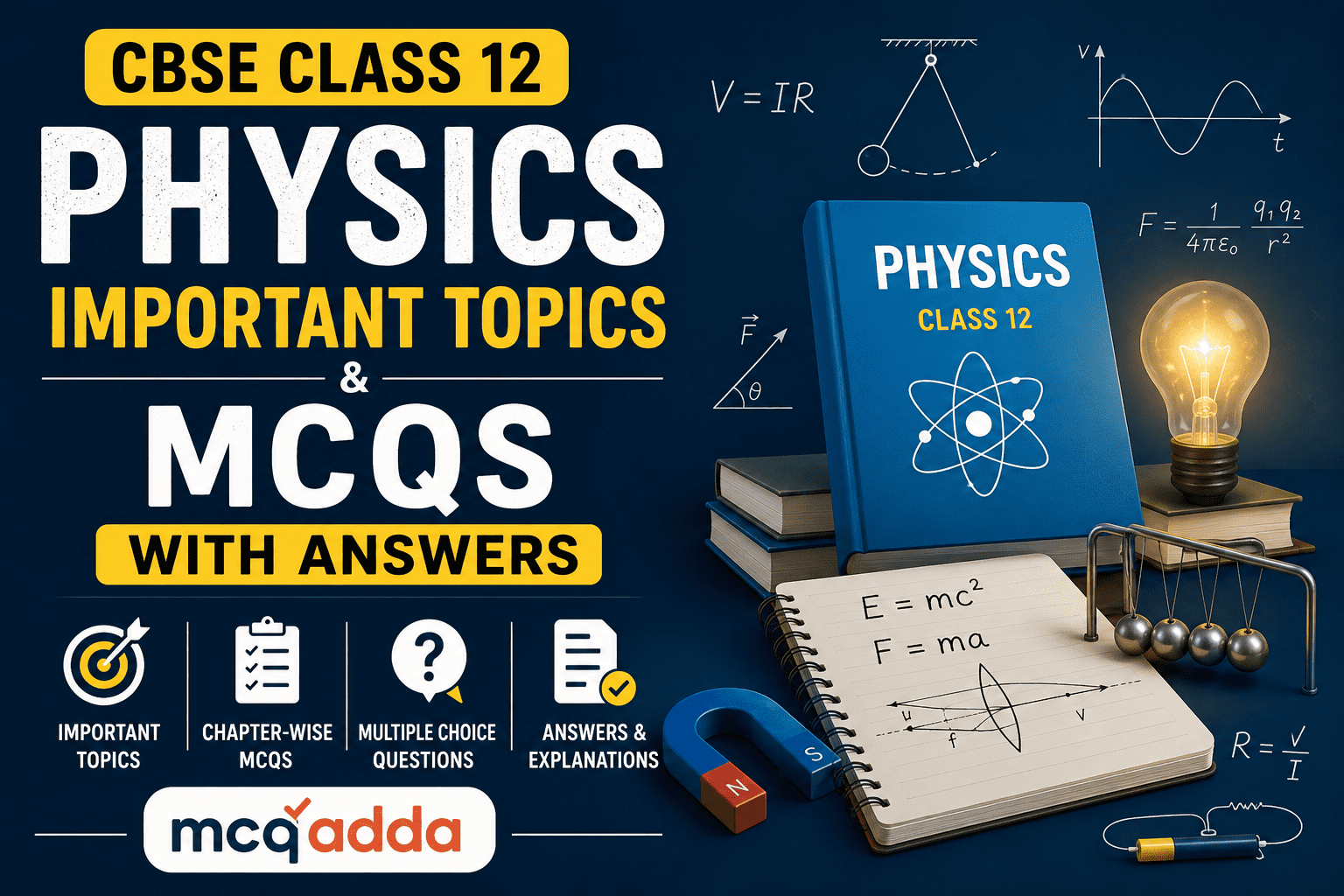
Preparing for the CBSE Class 12 Physics board exam can feel overwhelming given the vast syllabus, but focusing on the right topics and practicing the right question formats makes all the difference. This article zeroes in on the most important topics from each unit—concepts like optics, electrostatics, magnetism, and modern physics—specifically for the Class 12 board exam. With MCQs now accounting for 30–40% of the 70-mark theory paper, the student who masters chapter-wise multiple choice questions has a massive advantage over one who only practises long-form derivations.
Yet most students make the same costly mistake: they solve random questions from random sources, get no feedback on why they were wrong, and repeat the same errors right up to exam day. This guide fixes that. Below you will find every chapter of the CBSE Class 12 Physics syllabus broken down into high-yield MCQ topics, 2–3 carefully chosen questions with full explanations, and — most importantly — the exact common mistake that trips students up on each one. Work through this chapter by chapter, and you will not just memorise answers; you will understand Physics well enough to handle any MCQ the board throws at you.
Why chapter-wise MCQs are critical for Physics
Ready to test yourself with unlimited, non-repeating MCQs?
Start free Physics MCQ practice — all 14 chapters, NCERT-aligned syllabus, with instant explanations and common mistake notes.
Start free MCQs practice →Pro tips to master Class 12 Physics MCQs
| Strategy | How to apply |
|---|---|
| Formula sheet first | Physics MCQs are 60% formula-based. Build a one-page formula sheet per unit before attempting any MCQs. Priority chapters: Optics, Electrostatics, EMI, and Dual Nature. |
| Unit analysis trick | When unsure of an answer, check the units of each option. Eliminating dimensionally inconsistent options can narrow four choices down to two in seconds. |
| Chapter-by-chapter mastery | Start with high-yield chapters (Electrostatics, Optics, Dual Nature). Move to the next chapter only when you can solve 10 consecutive MCQs without error. |
| Conceptual vs numerical | CBSE boards favour conceptual MCQs (Lenz's law, dielectric effect, energy bands). NEET favours numericals. Practise both types for every chapter. |
| Assertion-reason prep | CBSE has expanded assertion-reason questions. Practise identifying: (a) whether both A and R are true, and (b) whether R correctly explains A. |
| Mistake journal | Write down every wrong answer and the exact reason you chose incorrectly. Review this before the exam — it is more valuable than re-reading the textbook. |